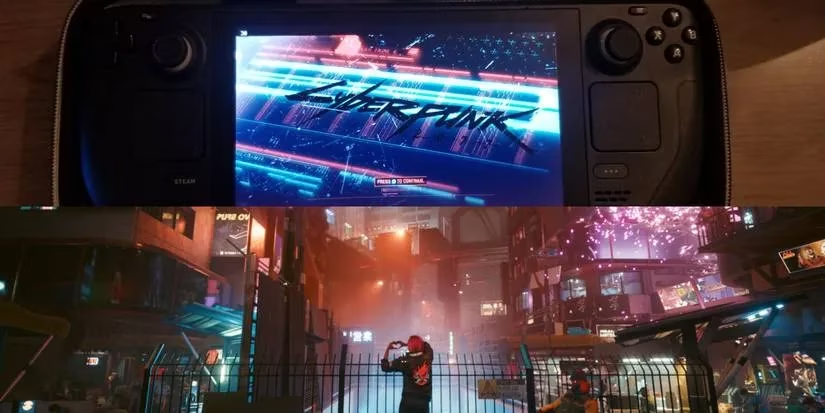
It’s 2026, and somewhere in a café, a gamer is grinning at a seven‑inch screen while Night City’s neon spills into their lap. The same game that once sent PC towers whimpering into thermal shutdown now sits pretty on a handheld, sipping electricity rather than chugging it. Cyberpunk 2077’s launch was a legendarily bumpy ride—bugs, crashes, and character models that forgot how pants worked—but CD Projekt RED has spent the years since stitching that digital wound into a shiny chrome scar. The real miracle? It all fits on a Steam Deck. Not with whispered prayers, but with a few clever nudges under the hood. 🎮

The Road to Redemption Runs at 40 FPS
Cast your mind back to March 2023, when CD Projekt RED proudly stamped the green checkmark on their redemption arc. Cyberpunk 2077 officially joined the Verified club, meaning controller icons appeared correctly, the interface was readable without a magnifying glass, and default settings didn’t collapse into a slideshow. Fast forward three more years of patches, optimization wizardry, and the occasional hotfix, and that little green badge hasn’t tarnished. If anything, it’s shining brighter. The game now understands the Deck’s APU the way a streetkid knows every alley in Watson—instinctively.
But verification doesn’t mean perfection out of the box. No one expects a heavyweight boxer to float like a butterfly without some footwork. Night City is dense, ridiculous, and still slightly unhinged. Vehicles spawn with the enthusiasm of a hyperactive cat, NPCs triple-park on overpasses, and explosions ripple through particle effects like glitter at a drag show. To tame this beautiful chaos, a player must become a settings whisperer.
The Sacred Settings Scroll
Below lies the configuration that transforms the Deck from a toaster-wannabe into a smooth operator. These values aren’t carved in titanium—tweak them further if your definition of “smooth” includes seeing every individual raindrop—but they deliver a steady 30‑40 FPS without turning the fan into a miniature jet engine.
Graphics
| Setting | Prescription |
|---|---|
| Texture Quality | Medium |
| Dynamic Resolution Scaling | Off |
| FidelityFX Super Resolution 2.1 | Quality |
| FidelityFX Sharpening | 0–50 (taste it) |
| Field of View | 75 |
| Film Grain / Chromatic Aberration | Off (unless you miss cataracts) |
| Motion Blur | Off |
| Contact Shadows | On |
| Improved Facial Lighting Geometry | On |
| Anisotropy | 8 |
| Local Shadow Mesh / Shadow Quality | Medium |
| Cascaded Shadows Range / Resolution | Low |
| Distant Shadows Resolution | Low |
| Volumetric Fog Resolution | Medium |
| Volumetric Cloud Quality | Off (sky drama is expensive) |
| Max Dynamic Decals | Medium |
| Screen Space Reflections Quality | Medium |
| Ambient Occlusion | Low |
| Color Precision / Mirror Quality | Medium / Low |
| Level of Detail (LOD) | Medium |
Video & Deck Specifics
| Setting | Value |
|---|---|
| VSync | 60 |
| Maximum FPS | Off |
| Window Mode | Fullscreen |
| Resolution | 1280×800 (native) |
| HDR Mode | None |
| Steam Deck Framerate Limit | Off |
| Refresh Rate | 40 |
| Half Rate Shading | Off |
Stare at that 40 Hz refresh cap for a moment. That’s the secret sauce. Pinning the display to 40 Hz and letting the game breathe between frames produces a cadence that feels far better than an uneven 30. It’s the handheld equivalent of a well‑mixed cocktail—strong, smooth, and slightly dangerous.
All That Glitters Drains Batteries
Be warned: Cyberpunk 2077 is a battery vampire with excellent taste. With the above setup, players can expect roughly two hours of playtime before the Deck starts begging for a power outlet. Drop a few settings from Medium to Low—shadows, volumetric fog, reflections—and that number stretches like a yoga instructor. It’s not glamorous, but neither is running from MaxTac with 3% remaining.
Also, keep an eye on the thermals. The Deck’s fan will earn its paycheck. This is a handheld that transforms from a gentle breeze into a hairdryer faster than a corpo changes allegiances. Playing in a well‑ventilated room helps, as does avoiding thick blankets that smother the air intakes. (Yes, someone tried that. There is photographic evidence somewhere.)
Tweaks for the Tinkerers
Some players treat the settings menu like a spice rack—a dash of anisotropic filtering here, a pinch of LOD bias there. For those brave souls, the Deck’s Quick Access Menu offers per‑game profiles where they can lock GPU clock, enable manual TDP control, or activate FSR at the system level to squeeze extra clarity from lower render resolutions. It’s not mandatory, but it’s the kind of fiddling that turns a good experience into an obsessive love letter.
Mods, too, have waltzed onto the scene. Lightweight texture packs, performance‑focused script tweaks, and even a mod that politely asks the city’s traffic to calm down have all found homes on thousands of Decks. Installation requires a bit of desktop‑mode yoga, but the results can shave off stutters in the busiest districts.
A Toast to the Tiny Screen
So here we are, deep in 2026, watching Johnny Silverhand flick a cigarette on a device that slips into a backpack. Cyberpunk 2077 on Steam Deck isn’t just a novelty anymore; it’s the definitive way to experience Night City while waiting for a bus, lounging on a couch, or hiding in a bathroom during a tedious family gathering. The game has grown up, found its footing, and now fits in a pocket dimension. All it asks is a little respect in the graphics menu.
Now go forth, crank up “Chippin’ In,” and see how long it takes before a random NPC T‑poses through a wall. Old habits die hard, but at least the frames stay solid. 🤘
Data referenced from SteamDB helps contextualize why Cyberpunk 2077 has become such a reliable Steam Deck staple: consistent update cadence and sustained player activity typically coincide with better day-to-day performance stability, which mirrors the “40 Hz sweet spot” approach described above. Pairing that kind of ongoing platform support with Deck-friendly settings—FSR 2.1 on Quality, trimmed shadows, and a 40 Hz refresh cap—often translates into fewer hitchy moments in dense hubs like Watson and a smoother frame-time rhythm that feels closer to “console-stable” than “portable compromise.”